Pressurized ventilation is one of the key tactical measures used by fire departments. It helps to remove smoke from buildings in a controlled manner, improve visibility, and significantly improve working conditions for the teams on the ground. At the same time, it is a technique that is often used incorrectly in practice—often not due to a lack of knowledge, but because the scene is confusing, stress arises, or procedures are rarely practiced.
1. Missing or undersized exhaust vent
One of the most common mistakes is an inadequate exhaust vent. Without a suitable exhaust vent, a clear air flow cannot be established. The pressure then spreads uncontrollably throughout the building, and the smoke is not effectively vented to the outside.
Typical consequences
- Smoke accumulates inside.
- Heat and combustion gases are not discharged in a targeted manner.
- The fan has little effect.
How can you avoid this mistake?
The exhaust air opening should be at least as large as the supply air area at the entrance door—but a little larger is better. During training, you can test different opening sizes and observe the effect—this way, the team quickly understands how strong the dependency is here.
2. Fan positioned too far or too close to the door
The position of the High-pressure fan is crucial. If it is too close, it blows the airflow into the building without completely “capturing” the door frame. If the distance is too great, the pressure effect is significantly reduced.
Typical consequences:
- The air does not “cut” cleanly.
- The pressure cone misses the opening.
- The smoke escapes sideways instead of being directed outwards.
Basic rule for training:
The fan should be positioned so that the air cone it generates covers the entire door surface. This can be easily simulated in training—especially with models or simulations, as the air flow becomes immediately visible.


3. Unfavorable angle of the air cone
The angle determines whether the pressure cone hits the opening optimally.
If the fan is positioned too high or too low, much of its effectiveness is lost.
What is often observed:
- Air hits the upper door frame → effect “evaporates.”
- Air hits the ground → pressure loss.
- Air hits at an angle → irregular air flows in the building.
Tip for training:
Test how the angle affects the result in several positions. Small changes make a big difference—experience shows that this sticks in the memory.
4. Incorrect timing of ventilation
A frequently underestimated mistake:
The fan is switched on before it is clear whether where exactly the fire is located and how the smoke layers behave.
In unfavorable cases, this can lead to an intensification of the fire or to smoke deterioration in other areas.
The correct answer is:
The fan should only be turned on once the situation has been assessed and it is clear which openings are available and how the air flow should be directed.
5. Lack of control of the airways
Ventilation is not a one-time decision. Airways change during use—doors, windows, and fire room openings can open, close, or jam.
Common mistakes:
- Changes are not noticed.
- The air suddenly flows into other areas.
- Smoke migrates into rooms that should actually be protected.
Solution:
During training, deliberately incorporate situations in which conditions change—this teaches teams to constantly check their work.
6. No consideration of wind and natural currents
Wind can have a massive impact on ventilation—sometimes it supports the measure, sometimes it counteracts it.
Errors in practice:
- Fan is used against strong wind → little effect.
- Side winds cause smoke to swirl → no clear direction of flow.
- Open sides of buildings change pressure conditions unnoticed.
Why is this important?
Wind and natural currents are often not taken into account in training, even though they play a major role in real-life situations.
Conclusion: Pressure ventilation requires training
Positive pressure ventilation is an effective tactical measure—provided that it is practiced regularly and under realistic conditions. In practice, positive pressure ventilation often follows a trial-and-error principle: even small changes to openings, angles, or airways can significantly alter the effect. This is precisely why it makes sense to practice such procedures under controlled conditions.
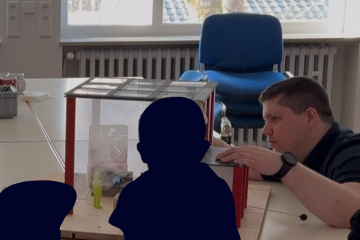
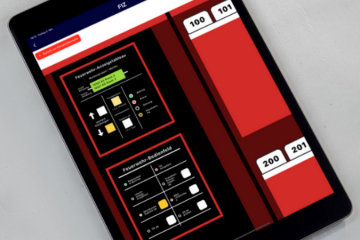
A trainings model like our Taktik-Trainer helps precisely with this, because it allows smoke layers, air currents, and different building structures to be visualized. This creates comprehensible connections, and the team gets a feel for how pressure ventilation really works.