Explaining a fire brigade route card in the training room is one thing. Using that route card to navigate through an unfamiliar building to the activated detector is another.
With the Fire Alarm System Trainer, this is exactly what can be practised: the real building becomes the training environment while the fire alarm system is simulated digitally. The FSD, FIZ, fire brigade route cards and activated detectors can all be integrated into the exercise without having to use the building’s actual fire alarm system.
This allows firefighters to practise the procedures of a fire alarm system incident where they ultimately need to work: inside the building.
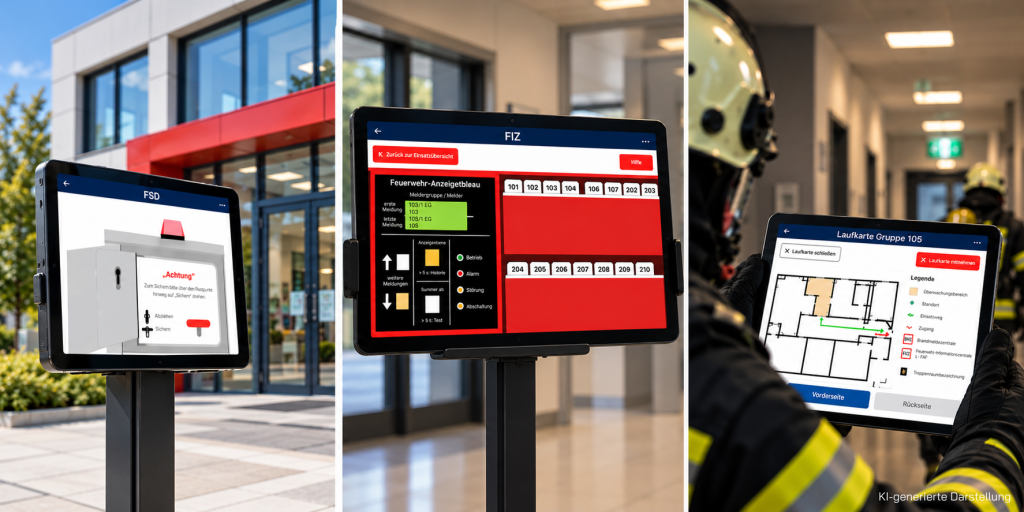
From the FSD to the Activated Detector
For the exercise, the FSD and FIZ can be positioned exactly where they are located in the actual building. Participants then work through the incident scenario step by step:
Open the FSD → Check the FIZ → Identify the detector group → Retrieve the fire brigade route card → Investigate the building → Locate the activated detector.
This automatically introduces factors that are difficult to replicate in a classroom setting: actual distances, multiple floors, stairwells, junctions, different access routes and navigating through the building using the fire brigade route card.
Use Existing Fire Brigade Route Cards Directly
Preparation is particularly straightforward for buildings that already have fire brigade route cards.
These can be imported into the Fire Alarm System Trainer as an image or PDF. The corresponding detectors can then be positioned directly on the route card and assigned to the appropriate detector groups.
This allows firefighters to train with the same fire brigade route cards that are available to them for the actual building.
This makes the Fire Alarm System Trainer particularly useful for:
- buildings with fire alarm systems within your own response area
- Schools and kindergartens
- nursing homes
- Office buildings
- Commercial and industrial facilities
- larger public buildings
Create Your Own Training Building
If no existing fire brigade route card is available, the building can be created directly in the Fire Alarm System Trainer’s floor plan editor.
Floors, rooms, staircases, the fire alarm control panel (BMZ/FIZ), detector groups and individual detectors can be positioned to match the training building.
Based on this information, the Fire Alarm System Trainer automatically generates the required fire brigade route cards. These can then be further customised and used for the exercise or printed. This means that even a building without its own fire alarm system can be used as a training environment for fire alarm system incidents.
Up to Four Devices for a Realistic Training Scenario
For training in a real building, the Fire Alarm System Trainer can be distributed across up to four devices. This allows the individual stations and roles to be physically separated and the procedure of a fire alarm system incident to be practised step by step throughout the building.
One device serves as the FSD and can be positioned where the actual fire brigade key safe is located. A second device represents the FIZ at its corresponding location within the building.
Another device can be used by the attack team. The selected fire brigade route card is transferred digitally at the FIZ and is then available on this device for the investigation inside the building.
With the pager role, a fourth device can also be integrated into the exercise to receive the corresponding alarms.
This means the exercise does not take place with everyone gathered around a single tablet. Participants move between the FSD, FIZ and investigation area, work with different devices and take on different tasks within the same incident scenario.
Actually Locate the Activated Detector
With our detector mock-ups, the digital exercise can also be combined with the real building.
The detector mock-ups are placed at selected locations before the exercise begins and can be activated with a visual flashing signal.
The task does not end when firefighters reach the correct door: using the fire brigade route card, they must navigate to the relevant area and locate the detector that has actually been activated.
This creates a direct connection between the digital training scenario and the physical investigation of the building.
Train Different Incident Scenarios in the Same Building
The same building does not always have to be used for the same training scenario.
Die Übungsleitung kann unterschiedliche Melder auslösen, mehrere Meldergruppen einbeziehen oder während der laufenden Erkundung weitere Ereignisse hinzufügen.
This allows a variety of scenarios to be practised, for example:
- activation of a single detector
- multiple activated detectors
- subsequent alarm during the investigation
- different detector groups and building areas
- investigation across multiple floors
- different fire brigade route cards and access routes
The real building remains the same – the incident scenario can be changed again and again.
Fire Alarm System Training Where It Matters Most
With the Fire Alarm System Trainer, theoretical knowledge and practical building investigation can be combined.
The fire alarm system is simulated digitally. FSD, FIZ, fire brigade route cards and detector activations form the basis of the training scenario. At the same time, firefighters physically move through the building, navigate using the fire brigade route card and locate the corresponding detector.
This turns fire alarm system training into a complete building-based exercise – from the FSD to the activated detector.