The turntable ladder is one of the most important specialized vehicles in fire service operations. It creates rescue routes, opens up tactical options, and shapes operational planning within the very first minutes of an incident. That makes it all the more important not just to discuss its use in theory, but to train for it in a targeted way as part of training.
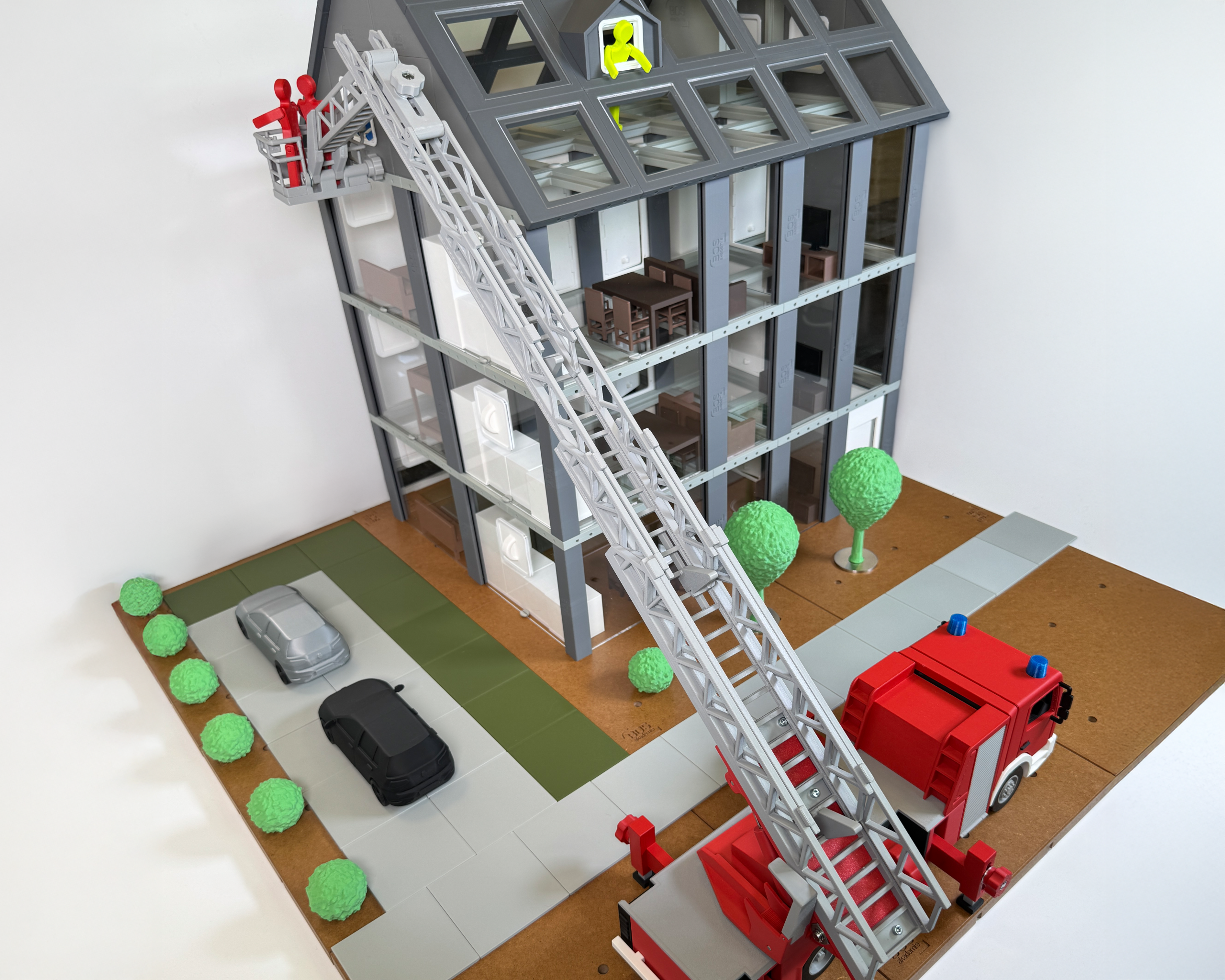
With the new Drehleiter-Trainer, a true-to-scale addition to the Taktik-Trainer is now available for exactly this purpose. It lets you practice incident scenarios in which the turntable ladder plays a decisive role: from rescuing people from upper floors, to choosing the right ladder placement, all the way to an exterior attack from the basket.
Why turntable training is so important
The use of a turntable ladder does not begin when the ladder set is extended. Even before that, the crew has to make key decisions: choosing a suitable setup area, assessing which side of the building makes the most tactical sense, and checking which floors can actually be reached from that position. They also have to evaluate obstacles, distances, and the ground conditions. Just as important is the question of whether the turntable ladder primarily serves as a rescue route, an attack route, or both in the given scenario.
This is exactly where the Drehleiter-Trainer comes in. It makes tactical decisions visible and easier to discuss before emergency crews have to make them under time pressure in a real incident.
Correctly assessing setup areas and ladder placement points
A common pitfall during operations is not the turntable ladder itself, but planning for it too late or in an unfavorable way. If the setup area is not considered early enough, valuable time can be lost when it matters most. Building projections, parked vehicles, narrow access routes, or unsuitable ground conditions can change the situation immediately.
For this reason, turntable ladder training should not only address where the ladder could theoretically be positioned. Trainees should primarily learn what really matters when choosing the right position. This includes obstacles, distances, ground conditions, and safety aspects. These are exactly the points summarized by the well-known HAUS rule for aerial rescue vehicles.
With the Drehleiter-Trainer, trainees can realistically work through these considerations and integrate them directly into their tactical planning.
Rescue operations and an alternative attack route
In many incident scenarios, the turntable ladder is not just a supporting resource, but the only safe rescue route, for example when stairwells are filled with smoke or access through the inside of the building is no longer possible.
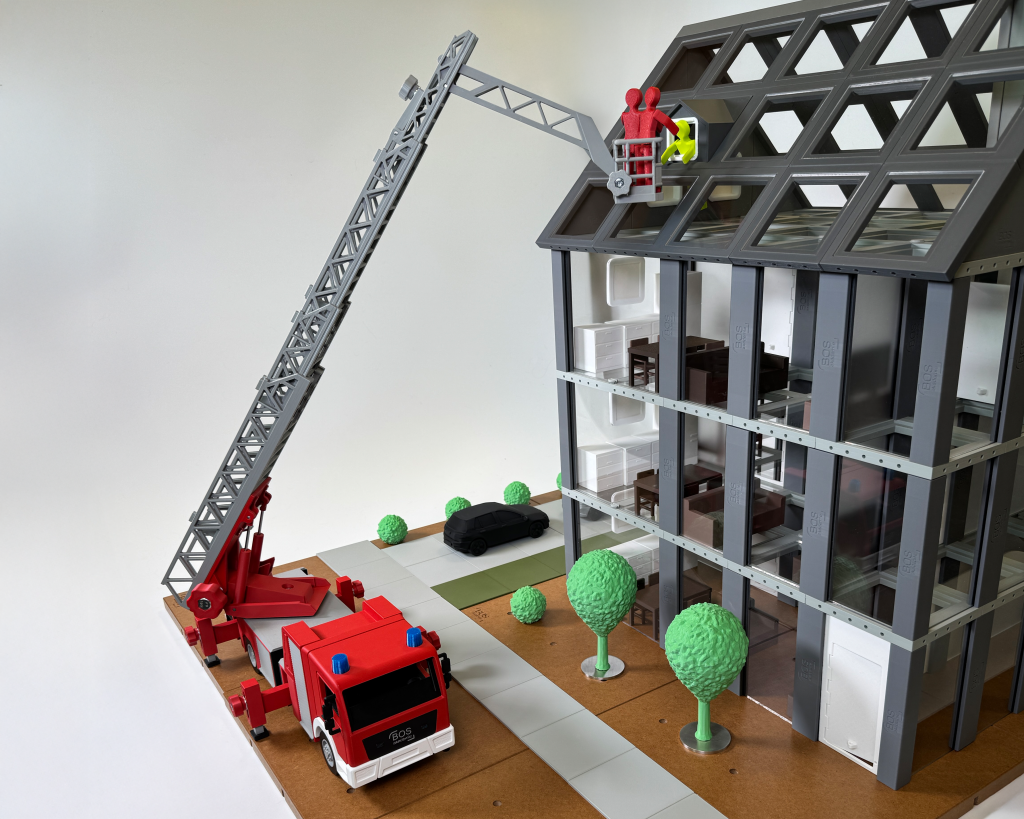
The Taktik-Trainer allows these exact scenarios to be practiced in a targeted way: In which situation does the turntable ladder primarily serve as a rescue route? Under what conditions can it also create an alternative attack route for the crew? And at what point does an exterior attack from the basket make tactical sense, or become a lower priority?
These kinds of questions are also a central part of real-world initial and ongoing training involving aerial rescue vehicles.
Better understanding tactical connections
During operations, the turntable ladder never works in isolation. It is always connected to the attack crew, the water supply, and incident command. That is exactly why the Drehleiter-Trainer is especially well suited for making these interactions visible in a training context.
What changes if the initial setup area becomes unavailable? How does repositioning the turntable ladder affect rescue operations? Which personnel does it tie up during this phase, and where might they then be missing? This also makes it much easier to assess the priorities between rescue, interior attack, and exterior attack.
With the Drehleiter-Trainer, instructors can discuss these decisions step by step and then evaluate them together afterward.
Typical pitfalls in turntable ladder training
Especially in training, it is worth making recurring sources of error visible at an early stage. These include:
- involving the turntable ladder too late in operational planning
- a setup area that appears suitable, but is actually unsuitable
- incorrectly assessing which floors can be reached
- a ladder placement point that is technically possible, but tactically unfavorable
- an exterior attack even though rescue operations or an interior attack should take priority
- viewing the turntable ladder as an isolated measure instead of part of the overall operational concept
These points become especially clear when working with the model, because decisions are immediately visible and can be discussed directly.
Versatile use in training and instruction
The Drehleiter-Trainer was developed as a true-to-scale addition to the Taktik-Trainer and can be combined with all existing training objects. This allows realistic scenarios to be created in which setup areas, ladder placement points, rescue routes, and attack options can be assessed directly on the model.
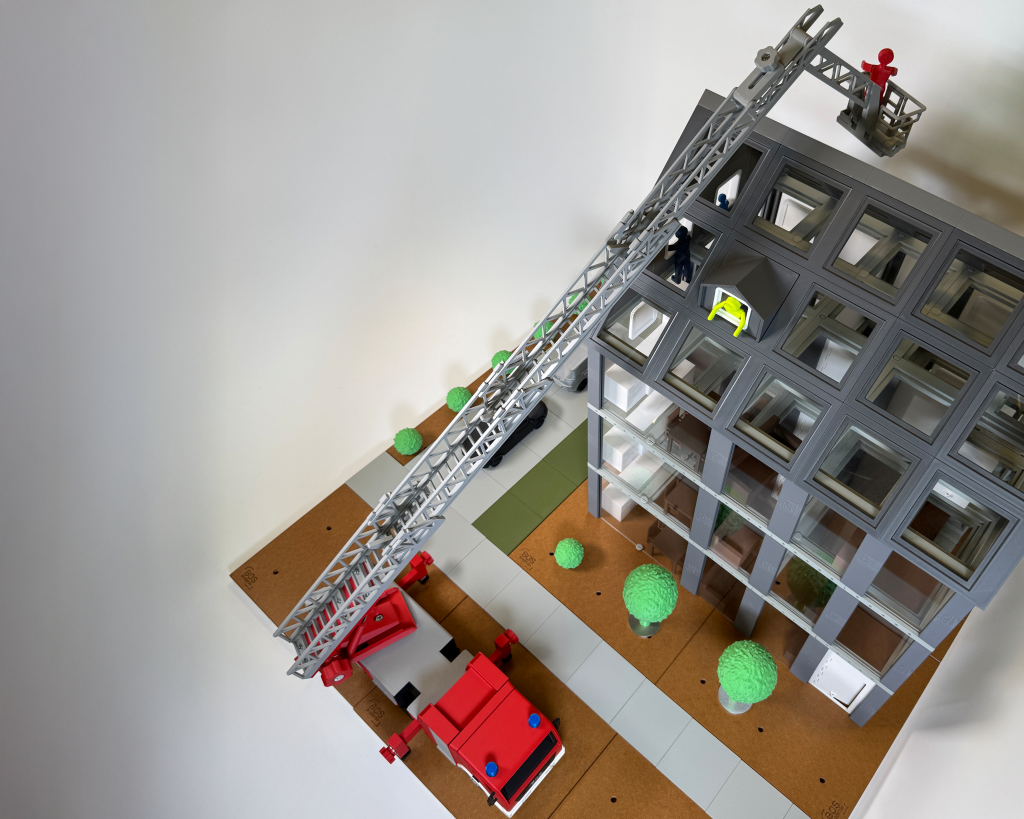
In addition, the Drehleiter-Trainer is also suitable as a standalone demonstration model, for example for vehicle familiarization, instruction, or demonstrations. This makes it a versatile training tool that goes far beyond pure tactical training.
Conclusion: Making turntable ladder training visible and practical
With the new Drehleiter-Trainer, we are expanding the Taktik-Trainer with a vehicle that plays a decisive tactical role in many incident scenarios. It helps trainees not only understand the technical operation of the turntable ladder, but above all practice making the right decisions around positioning, rescue operations, attack routes, and tactical coordination.
Because that is exactly what turntable ladder training is about: not only knowing that a turntable ladder can be used, but recognizing when, where, and why its use can make the difference.