



Description
The Aerial Ladder Trainer is one of the most important special-purpose vehicles in firefighter training and therefore deserves a permanent place in tactical education. As an extension to the Taktik-Trainer it enables realistic training for scenarios in which an aerial ladder plays a key role – from rescues from upper floors to exterior firefighting operations using the basket.
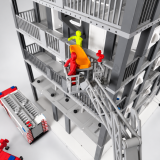
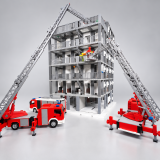
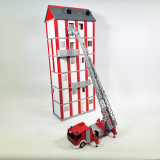
For targeted aerial ladder training, the Aerial Ladder Trainer can also be equipped with our modular building facade They can be combined. This allows for the quick setup and flexible modification of different building heights, ladder positions, balconies, and roof shapes during an exercise – without having to assemble a complete Taktik-Trainer. In combination with our HLF Additionally, vehicle positioning, distances and the interaction of different emergency vehicles can be clearly incorporated into the exercise.
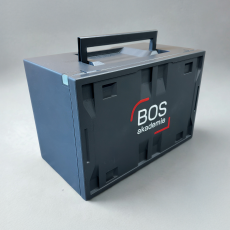
With our Transport box , you can safely store and transport the Aerial Ladder Trainer.
Planning Setup Locations Correctly
Where can the aerial ladder actually be positioned, and which floors can be reached from that location? This question arises at every incident, making it an important part of firefighter training. With the Taktik-Trainer, crews can practice identifying suitable setup locations, evaluating ladder access points, and incorporating aerial ladder positioning into their tactical planning. This helps participants develop a better understanding of the vehicle’s capabilities and limitations before having to make decisions under real-world time pressure.
Rescue Operations and Access Routes
In many incidents, the aerial ladder provides the only safe rescue route—for example, when stairwells are filled with smoke or access routes are blocked. With the Taktik-Trainer, these scenarios can be practiced in a realistic way: When should the aerial ladder be used for rescue operations, and when can it also serve as an alternative access route for crews? Participants can also evaluate whether an exterior attack from the basket is appropriate or whether an interior attack should take priority. The Taktik-Trainer makes these tactical decisions visible and provides an ideal basis for discussion and evaluation after the exercise.
Understanding Tactical Relationships
The aerial ladder never operates in isolation. During an incident, it must work in coordination with the attack crew, water supply, and incident command. This makes the Taktik-Trainer an ideal tool for illustrating these operational relationships. How does the situation change if the aerial ladder has to be repositioned for a second rescue? What impact does this have on the overall strategy? Scenarios like these help participants develop a deeper understanding of tactical decision-making while also improving communication and coordination between crews.
Drehleiter-Trainer - Versatile Training Opportunities
The Aerial Ladder Trainer is designed as a scaled-down supplement for the Taktik-Trainer It is designed and can be combined with all existing training objects. For exercises focusing on aerial ladder tactics, the following is also available: modular building facade available. It allows for quick and flexible setup in different building situations and can be modified in just a few steps during training.
Furthermore, the Aerial Ladder Trainer is also suitable as a standalone teaching aid – for example, for vehicle familiarization, briefings, or demonstrations. This makes it a versatile training tool that goes far beyond pure tactical training.
Features
- Scale model designed as an extension for the Taktik-Trainer, approximately 1:18 scale
- Training setup locations, ladder access points, and vehicle positioning
- Training scenarios for rescue operations and exterior attacks from the baske
- Planning alternative access routes using the aerial ladder
- Promotes tactical coordination between the aerial ladder operator, attack crew, and incident command
- Compatible with all Taktik-Trainer training modules
- Can also be used as a standalone training aid for vehicle familiarization and instructional sessions
Note
The model is intended solely as a training and demonstration aid and does not include any electrical or functional components.